
Reading List, Peter Marley, 2014
Mono no aware
In some ways the haiku and the photographic image are very similar: they have a restrictive structure, the poems are limited by syllable count and the images are curtailed by the edges of frame. In such a way this limited amount of information makes them perfect mediums for rendering an impression of something, a fleeting glimpse at something now past, or capturing the atmosphere of a person, place or moment.
The Japanese philosophy of mono no aware relates to the celebration of transience or (more literally) 'the passing of things'. This philosophy is first articulated in the seminal novel The Tale of Genji (circa 11th century, early Heian Period) by Shikibu Murasaki, it has long been attributed to Japanese poetry or paintings. The haiku poetry of Bashō Matsuo or the paintings of Hokusai Katsushika tended to focus on passing moments, and by recording and presenting these 'things' they celebrated their passing.

Untitled; Peter Marley; Killaloe, Ireland; July 2013
In such a way these concise and colourful fragments can be seen as snapshots of a time now gone. I use the term 'snapshot' as they are often moments that make up the artist's milieu, the somewhat mundane made fantastic. The subject matter that these artists drew upon was also commonly natural, such as the changing of the seasons or habits of flora and fauna.
The Books:

In Praise of Shadows, Tanizaki Junichiro (1933)
Tanizaki Junichiro was a famous Japanese author who wrote about family and society in a country undergoing rapid changes in the 20th-century. In his essay In Praise of Shadows Tanizaki discusses aesthetics and architecture, framing the differences of cultural appreciation and application between Eastern and Western worlds. He draws attention to the effect of light on particular substances and situations, such as the imperfections on lacquerware in a candlelit restaurant or ceramic tile in a toilet. It is his particular focus and appreciation for minute details, in relation to a culture wrestling with changing traditions, that makes me want to include it in this discussion.

Moriyama Daido, The World through My Eyes (2010)
Keeping in the 'shadows' for now, I'll be presenting striking monochromatic monographs The World through My Eyes, by Moriyama Daido, and Veins, a dual photo book combining the work of Scandinavian photographers Anders Petersen and Jacob Aue Sobol. Moriyama's photobook is an amalgam of his earlier work and spans the majority of his career (from mostly the 1950s-1970s). His particular style is a provocative and roving, curious and tireless. He is drawn to faces in the crowd, animals in the street, reflections, advertising text, and day to day details. His aesthetic style was considered avant-garde when compared to the classical Japanese photographers and the photojournalists operating in post-WWII Japan.

Untitled, Moriyama Daido

Stray Dog, Moriyama Daido, Aomori, 1971
The result is a loose photo-diary where a collage of moments make up a chronology of personal impressions, the documentary nature of photography becoming more individualistic than traditionally objective. This aesthetic shift also appears in Western photography and comes at the hands of Robert Frank and William Klein, who started to deviate from formal compositions and the hitherto established rules.

Anders Petersen & Jacob Aue Sobol, Veins (2013)
On the opening pages of Moriyama's The Hunter (1972), an earlier photo book, he cites Jack Kerouac's On the Road (1957) as a reference to the continuously fleeting method to his photography. This stream of consciousness photography, as it was termed, later included the photography of William Eggleston, Larry Clarke, Martin Parr and Nan Goldin (to name but a few).

Anders Petersen, VEINS

Anders Petersen, VEINS
And this is where Anders Peterson and Jacob Aue Sobol come in, thematically and tonally they are closer to Moriyama (hence their inclusion here), but they represent the Scandinavian side of this personal, or diaristic, method of photography in VEINS. Again they present people, places and impressions or moments to build an atmosphere.
Like in Tanizaki's writings, each of these photographers are drawn to specific details or textures: where Tanizaki moons over the "glow of grime" (pg. 20) that improves how light and shadow affect the lacquerware, Petersen and Sobol are drawn to the stains and imperfections in themselves and society. VEINS is, like The World through My Eyes, a reshuffle of previous projects the photographers have worked on refurbished with essays on their distinct aesthetic and approach to photographing.

Jacob Aue Sobol, VEINS

Kawauchi Rinko, AILA (2004)
Where Moriyama, Petersen, and Sobol document their worlds from the shadows and present their work in beautiful inky black and white there are photographs there are photographer's who utilise colour. Martin Parr's documentation of polite Western society, by comparison to the back streets of Shinjuku that Moriyama shows us, is always realised in full colour and this allows for commentary on commercialisation and advertising, branding and the general barrage on the senses that exists today.
Kawauchi Rinko is another photographer who opts for a diaristic and poetic method. Unlike Parr her tonal palette is more neutral or pastel based, and unlike the monochromatic photographers aforementioned who tend to underexpose or favour darker hues, Kawauchi tends to allow extra light to bleed into her images. Her particular focus, much like the haiku poets of yesteryear, is on the natural cycles that affect people, animals, seasons, plants and life in general as well the sporadic moments that punctuate those cycles.

Kawauchi Rinko, untitled from AILA, 2004
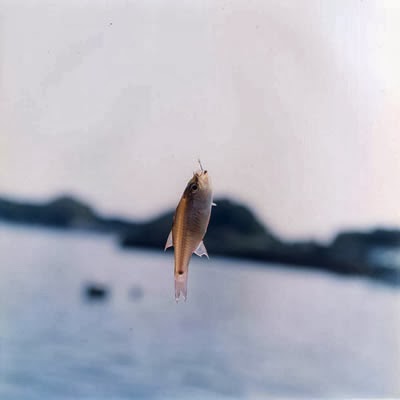
Kawauchi Rinko, untitled from AILA, 2004
From one lyrical colour source to another, Paul Graham's a shimmer of possibility is a weighty tome (originally printed as a series of twelve volumes) of moments - often phrased as 'filmic haikus'. This expression 'filmic haiku' is interesting as it marries cinema (filmic) and poetry (as I've been discussing here). By combining these terms it allows Graham's work to be approached from two very distinct angles. The twelve photo vignettes offer a fleeting and poetic vision of contemporary American life, where he has been drawn to "nothing moments in life", the elusive and ethereal rather than the tangible and obvious.

Paul Graham, a shimmer of possibility (2007)
And lastly, Jason Evans' NYLPT: this book could have appeared at any point in the series but I've opted to slot it in at the end. Evans is a very gifted photographer who covers all aspects and genres in his working practice. Ideally I would like to have presented images from his alternative website, The Daily Nice, onto which he adds a consistently interesting photograph every day. It functions as a live stream of consciousness from Jason Evans, and the images are not back catalogued or held there so each day is a unique insight or moment. Having visited this site for years now I have come to appreciate his humour through his framing, and NYLPT is full of humour (sometimes accidental, always wonderful).

Jason Evan, NYLPT (2012)
In this book Evans has returned to street photography and, like Moriyama or Frank, photographs what interests him in the urban environments: people, signs, traffic, trees, and so on. However, each roll of film that was shot was used twice over (by rewinding the film and double exposing the negatives) and this provides plenty of space for happy accidents. This is a definite record of Evans' personal vision, his stream of consciousness, his celebration of all things fleeting - twice over.


Jason Evan, NYLPT


